
Sampling at 25–30 Days: An OEM Jewelry Schedule
The master sample is the longest block in a custom order. Between approved CAD and a physical piece in your hand sit 25–30 days of wax printing, casting, stone setting, polishing and electroplating. Mass production then takes 3–4 weeks, and the CAD stage before it all takes under 48 hours — which is why a launch date is built backwards from sample approval, never forwards from the shipment date.

Key takeaways
- Master sampling runs 25–30 days and covers five named operations from wax printing to electroplating.
- Mass production adds another 3–4 weeks once the sample is signed off.
- 3D CAD and renderings land inside 48 hours, so screens are never the bottleneck in an OEM/ODM order.
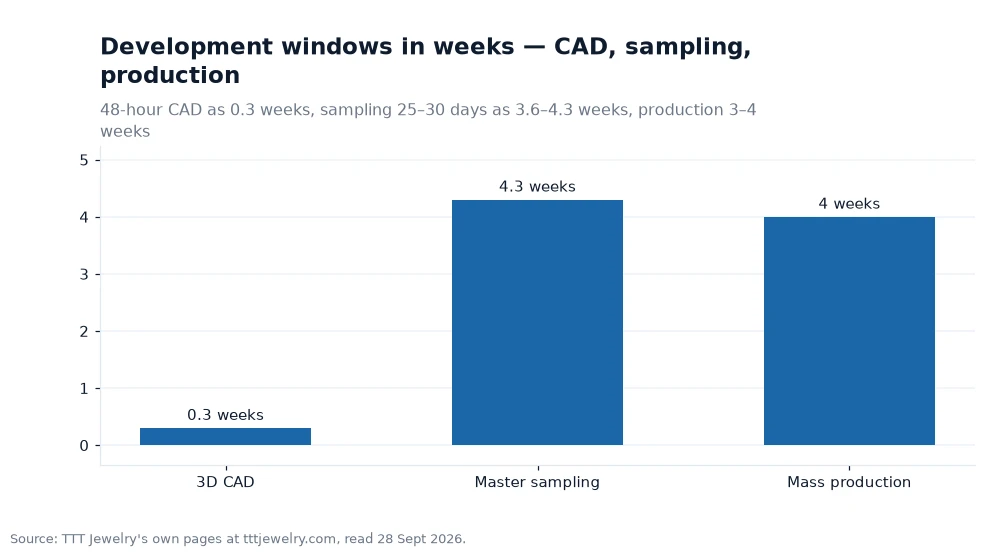
- In one unit, the three published windows read as roughly 0.3, 4.3 and 4 weeks.
Why the sample block dominates the calendar
A sample is not a fast piece made on a slow schedule. It is a full production run of one, and it goes through the same stations as a batch of five hundred: a wax model printed from the CAD file, a mould cast from that model, the stones set by hand, the surface polished to a high gloss, then the plating stack applied.
Every one of those stations has a queue. That is the honest explanation for 25–30 days, and it is also why a supplier who quotes a sample in a week is usually describing something else — a stock item pulled from a shelf, not a master sample built on your tooling.
Reading the three published windows in the same unit
The three timing figures are published in different units, so they are easy to misread. Converting them to weeks puts them on one scale and makes the schedule visible at a glance.
| Stage | Published window | What you owe the schedule |
|---|---|---|
| 3D CAD and renderings | under 48 hours | A complete brief with dimensions and material |
| Master physical sample | 25–30 days | A decision on the sample within a few days |
| Bulk production | 3–4 weeks | Approved sample and a firm piece count |
| Final QC and delivery | 100% inspected | Packaging artwork and a shipping address |
Two of those four rows are yours. A factory can only start the clock on the sample once the drawing is approved, and it can only start production once the sample is approved. Every day an approval sits in an inbox is a day added to the shipment date.
What the sample sign-off actually decides
The sample answers questions that a rendering cannot: whether the weight feels right in the hand, whether the stone sits flush, whether the brushed surface reads as brushed rather than scratched. It is the last point where an OEM jewelry manufacturer can change a tool without scrapping metal, which is why the review deserves a day of your attention rather than an hour.
Two verdicts matter. Approve, and the mould goes into production. Ask for a change, and the relevant station is rebooked — a plating change is cheaper than a stone change, and a stone change is cheaper than a dimension change, because dimensions come back to the drawing.
Where a schedule usually slips
Three things move the dates, and none of them is the factory's bench speed. The first is an incomplete brief: a piece count with no material, or a design with no plating choice. The second is a late approval, which pushes the next stage by exactly as many days as it was late. The third is a material change mid-sample — switching from a plated brass body to 925 sterling silver is not an edit, it is a new tooling route with a different minimum.
Keeping a project on its published windows mostly means answering questions within a day or two of being asked. That is what the 24-hour response on the workshop side is for.
Worked example: 48 hours, 25–30 days and 3–4 weeks in one unit
Start with CAD. Forty-eight hours divided by 24 gives 2 days, and 2 ÷ 7 = 0.29 weeks, which is the 0.3 week figure. Sampling at 25 days is 25 ÷ 7 = 3.57 weeks, rounding to 3.6; at 30 days it is 30 ÷ 7 = 4.29, or 4.3 weeks. Production at 3 weeks is 3, and at 4 weeks it is 4.
Add the three stages at their extremes. Fastest: 2 + 25 + 21 = 48 days, which is 48 ÷ 7 = 6.9 weeks. Slowest: 2 + 30 + 28 = 60 days, or 8.6 weeks. So the shop floor contributes somewhere between seven and nine weeks, and your own approval time is added on top of that figure. The conversions are my arithmetic; 48 hours, 25–30 days and 3–4 weeks are the published windows.
Planning a repeat order around the sample
The second order is a different animal. Once the mould and the finish are locked, there is no sampling stage to repeat unless you change the design, so a reorder is closer to the production window plus packing and shipping. That is the argument for deciding the whole collection before the first sample is signed off: each additional design added later needs its own mould and its own sample window, even if it shares the plating plan.
Brands running seasonal drops tend to sample the full range in one pass and then reorder the winners. It is slower at the start of the season and faster in the middle of it.
Four questions that keep the sampling window honest
Ask which stations handle your sample in-house. Wax printing, casting, setting, polishing and plating can all sit under one roof, or some of them can travel to a subcontractor, and a piece that leaves the building once tends to leave it twice. The answer tells you who is accountable when a stone is loose on arrival.
Then ask when the plating tank is next scheduled for your finish. A rhodium run and an 18K gold run are separate baths, so a sample waiting for one specific stack waits for that stack rather than for a free bench. Finally, ask what changes you may still request without resetting the clock — most benches will absorb a polishing note inside the window, and almost none will absorb a new band width.
Frequently asked questions
Can the sampling window be shortened for a simple design?
Sometimes, but not by much. Wax printing, casting, setting, polishing and plating all still happen; only the setting step gets meaningfully shorter on a design with no stones.
What happens if I reject the first sample?
The bench adjusts the relevant operation and rebuilds. A plating or polishing change is the quickest to correct; a dimension change goes back through the CAD drawing and then through the full sample route again.
Does the sample window include my approval time?
No. The 25–30 days is bench time. Every day the sample sits unapproved on your side is added directly to the shipment date.
Making the dates hold before the mould is cut
The simplest way to protect a launch date is to fix the five decisions that feed the schedule — base material, plating, stones, hallmark and packaging — in the first message, and to answer each approval request within a day. Everything else on the bench side is already published.
If the first order is a plated brass line rather than a precious metal one, the tooling and minimum differ, and the brass jewelry pages show how that route is finished. For buyers who want the question list in one place before the kick-off call, the published FAQ set is a shorter read than a spec sheet.
Where the numbers come from — the approved-sample benchmark, then the laser engraving option, followed by the 24-hour response commitment — is the maker's own pages through tttjewelry.com, in a visit dated 28 Sept 2026. ISO 9001:2015, the quality-management standard, is named on the same pages. The arithmetic in the worked example is my own arithmetic rather than the manufacturer's [1]